
How Much Can AI Automation Reduce Manual Work?
Businesses often underestimate how much time is spent on repetitive tasks like document review, email sorting, and data entry.
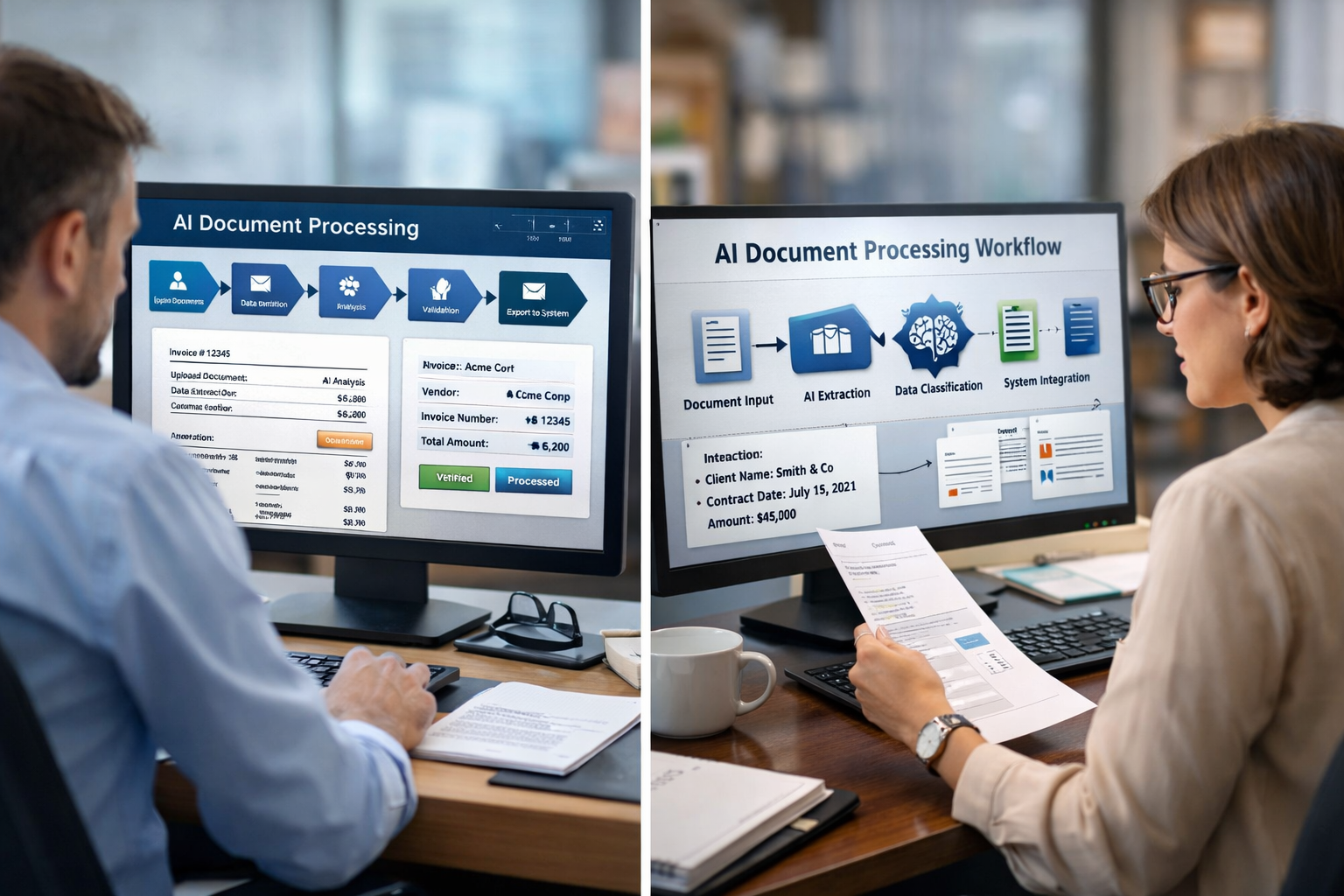
The potential reduction in manual work varies by industry and workflow complexity, but many organizations see dramatic improvements once AI automation is implemented.
In processes that rely heavily on document review or data entry, AI automation can reduce manual effort by 60 to 90 percent.
To understand why the impact can be so large, it helps to examine how work is typically performed today.
In many operations, employees spend significant time on activities such as:
- Opening emails
- Downloading attachments
- Identifying document types
- Reading documents
- Extracting information
- Entering data into internal systems
- Forwarding information to colleagues
These steps are necessary but rarely create strategic value.
AI automation can eliminate or streamline many of these activities.
For example, instead of a team member opening every email and reviewing attachments, an AI system can analyze incoming messages automatically. The system can determine which messages require attention, extract relevant information, and route the data to the appropriate systems.
Employees then review only exceptions or edge cases.
This model is often described as human-in-the-loop automation.
The AI system handles the majority of transactions while humans oversee the process and intervene when necessary.
Organizations that adopt this approach typically experience several measurable improvements:
- Faster processing times
- Reduced operational costs
- Lower error rates
- Increased processing capacity
Perhaps more importantly, employees spend less time performing repetitive tasks and more time focusing on work that requires judgment and expertise.
Over time, this shift can transform how organizations allocate their operational resources.
Rather than hiring additional staff to keep up with growing transaction volumes, companies can scale their operations using intelligent automation.
If you'd like, I can also write a single 2,000-word pillar article that combines these sections and is structured to rank for "AI business process automation" on Google and AI search engines. That would likely perform better for ClearGuide’s SEO strategy.
Reading is useful. A workflow assessment makes it concrete.
If a guide sounds like your business, ClearGuide can help you map the workflow and decide what is worth building first.